part 2 famous king
Agroecius (or Agroetius) was the name of a number of men from Roman history, most of them distinguished Gauls:
Consultus Fortunatianus, also known as C. Chirius Fortunatianus, was a Latin Christian rhetor who lived in the 4th-5th century AD, perhaps of African ancestry. He wrote an Ars rhetorica,[1] in three books. This work was published before 435, since it was used by Martianus Capella.[2] One of the manuscripts (Cod. Bodmer 146, 10th century) was owned by Francesco Petrarca, who studied and commented on it with many glossa.[3]
Pseudo-Probus was a 4th century grammarian, whose writings are sometimes referenced today in regards to Latin.[1]
Sulpicius Victor was a Latin rhetor who lived in the 4th century AD.[1] He wrote Instutiones oratoriae, dedicated to his son-in-law. The ony manuscript of this work has been lost and the editio princeps, which is the only reliable source, was printed in 1521
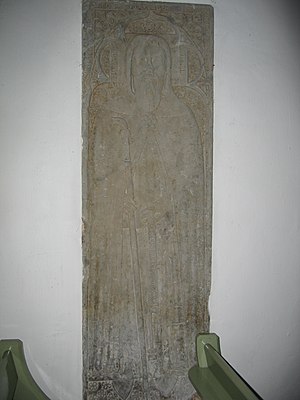 The 14th-century effigy of St Iestyn in St Iestyn's Church, Llaniestyn
JIN RAKSASA (? – c. 550 AD
Umi was given a number of royal tokens to prove he was the son of Liloa, including a lei niho palaoa. The lei (necklace) was made of braided human hair and whale bone. EDO TENSEI
Guillaume de Saint-André (fl. 15th/16th centuries) was the secretary and biographer of John IV of Brittany.

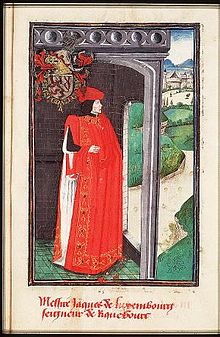 Jacques de Luxembourg, Seigneur de Richebourg (1426 – Nantes, 20 August 1487)
Jacques de Luxembourg as Knight in the Order of the Golden Fleece (Den Haag, KB, 76 E 10, fol. 71r)
Jacques de Luxembourg, Seigneur de Richebourg (1426 – Nantes, 20 August 1487)
Jacques de Luxembourg as Knight in the Order of the Golden Fleece (Den Haag, KB, 76 E 10, fol. 71r)


Tyfrydog (sometimes given as Tyvrydog)[1] was a Christian from north-west Wales in the fifth or sixth century, who was later venerated as a saint. He is said to have established a church in Anglesey, and although no part of the original structure remains, the current church is still dedicated to him. A nearby standing stone is said to be the remains of a man who he punished for stealing a bible from the church.
Consultus Fortunatianus, also known as C. Chirius Fortunatianus, was a Latin Christian rhetor who lived in the 4th-5th century AD, perhaps of African ancestry. He wrote an Ars rhetorica,[1] in three books. This work was published before 435, since it was used by Martianus Capella.[2] One of the manuscripts (Cod. Bodmer 146, 10th century) was owned by Francesco Petrarca, who studied and commented on it with many glossa.[3]
Pseudo-Probus was a 4th century grammarian, whose writings are sometimes referenced today in regards to Latin.[1]
Sulpicius Victor was a Latin rhetor who lived in the 4th century AD.[1] He wrote Instutiones oratoriae, dedicated to his son-in-law. The ony manuscript of this work has been lost and the editio princeps, which is the only reliable source, was printed in 1521
The Akatziri or Akatzirs (Greek: Άκατίροι, Άκατζίροι, Akatiroi, Akatziroi;[1] Latin: Acatziri) were a tribe that lived north of the Black Sea, west of Crimea.[2] Their ethnicity is undetermined: the 5th-century historian Priscus describes them as ethnic (ethnos) Scythians, but they are also referred to as Huns (Akatiri Hunni[1]).[3] A theory is that they were a Turkic tribe, their ethnonym connected to Turkic ağaç eri, "woodman".[3] Their name has also been connected to the Agathyrsi.[1] Jordanes (fl. 551) called them a mighty people, not agriculturalists but cattle-breeders and hunters.[3]
Roman emperor Theodosius II (r. 402–450)
Antonius (Ancient Greek: Ἀντώνιος) was a Greek monk, and a disciple of the Syriac ascetic saint Simeon Stylites. He lived around the year 460 AD.
Consultus Fortunatianus, also known as C. Chirius Fortunatianus, was a Latin Christian rhetor who lived in the 4th-5th century AD, perhaps of African ancestry. He wrote an Ars rhetorica,[1] in three books. This work was published before 435, since it was used by Martianus Capella.[2] One of the manuscripts (Cod. Bodmer 146, 10th century)
| Dhu Shanatir | |
|---|---|
| Reign | 478-490[1] |
| Predecessor | Dhu Ma'ahir (Hassan) |
| Successor | Dhu Nuwas |
| Born | Himyarite Kingdom (modern day Yemen) |
| Died | c. 490 Himyarite Kingdom (modern day Yemen) |
Saint Felix of Hadrumetum (died c. 434)
Honoratus Antoninus was a bishop of Constantia in the Roman province of Africa. He was alive during the persecution of the Catholics by the Vandal king Genseric (who adhered to Arianism) in the 5th century, around the year 437.
Valère de Langres or Saint Valère (died October 22, 411, also known as Saint Vallier),
Abraha (Tigrinya: አብርሃ) (also spelled Abreha, died after CE 570;[1] r. 525–at least 553[2]),
Valère de Langres or Saint Valère (died October 22, 411, also known as Saint Vallier),
Saint Patrick
| |
|---|---|
_-_stained_glass,_Saint_Patrick_-_detail.jpg)
Stained-glass window of St. Patrick from Saint Patrick Catholic Church, Junction City, Ohio
| |
| Bishop Apostle to the Irish | |
| Born | Britain |
| Died | Rathkeltair, Ulaid |
| Venerated in | Catholic Church Eastern Orthodox Church Anglican Communion[1] Lutheranism[2] |
| Major shrine | Armagh, Northern Ireland |
| Feast | 17 March (Saint Patrick's Day) |
| Attributes | Wears green bishop’s vestments. Generally shown holding a shamrock alongside either a crosier or a Bible. May also be shown alongside a cross, harp, serpent, demon, or baptismal font. |
| Patronage | Ireland, Nigeria, Montserrat, Archdiocese of New York, Roman Catholic Archdiocese of Newark, Boston, Rolla, Missouri, Loíza, Puerto Rico, Murcia (Spain), Clann Giolla Phádraig, engineers, paralegals, Archdiocese of Melbourne; invoked against snakes, sins[3] |
Argiovito, also referred to as Argiovitro, one Arbricio was bishop of Porto in Portugal during the late sixth century.
Ferrand of Carthage is a Christian theologian of the Roman province of Africa, modern day Tunisia ,[1] [2]who died in 546 or 547.

Martviri the Iberian or Sabatsmindeli (Georgian: მარტჳრი ქართველი; საბაწმინდელი) was a Georgian calligrapher, monk and writer of the 6th century.[1][2][3]
Saint Padarn
| |
|---|---|

St Padarn
| |
| Venerated in | Anglican Communion Eastern Orthodox Church Roman Catholic Church |
| Canonized | pre-canonical |
Mu’ayyad al-Dīn Abu al-Qāsim ibn Ḥasan ibn ‘Ajlān al-Ḥasanī (Arabic: مؤيد الدين أبو القاسم بن حسن بن عجلان الحسني) was Emir of Mecca twice between 1443 and 1447.
Nūr al-Dīn ‘Alī ibn Ḥasan ibn ‘Ajlān al-Ḥasanī (Arabic: نور الدين علي بن حسن بن عجلان الحسني) was an Emir of Mecca from 1441 to 1443.
Ivan Fedorovich Belka Otyaev (Russian: Иван Фёдорович Белка Отяев; second quarter of the 15th century - unknown) was the ambassador of tsar Ivan III in the Principality of Ryazan, the founder of the noble family of Belkin, the most likely founder of the village Belkin Repinskaya parish.
Paul Beneke, also Paul Benecke, (early 1400s (decade) - c. 1480)
Blodwell was ordained at Ely cathedral on 21 December 1448. He was also a Prebendary of Hereford.[3]
John Blodwell, DCL was a 15th-century priest.
Blodwel was born in Llanyblodwel and educated at the University of Bologna.[1] He held the living of Balsham in Cambridgeshire; was a Proctor of Durham[2] and Canon of St Davids; and Dean of St Asaph from 1418 until 1441.[3] He died at Balsham on 13 April 1462.
Cungšan (Manchu: ᠴᡠᠩᡧᠠᠨ[1][2]; Möllendorff: cungšan; Abkai: cungxan,Chinese: 充善; pinyin: Chōng shàn) was a chieftain of the Jurchen Jianzhou Left Guard. His Temple name is Chun Di (纯帝; Chún dì).
In 1442, a succession dispute between Cungšan and his half-brother Fanca led to a division in the Jianzhou Left Guard. Cungšan inherited his father's position as head of the Jianzhou Left Guard while his brother Fanca was made head of a new separate Jianzhou Right Guard by the Ming Dynasty. After the death of his half-brother Fanca, Cungšan brought the Right Guard under his control. [3]
Haraldur Kálvsson (or Harald Kalvsson), was, in the year 1412, lawman of the Faroe Islands.
György Lépes (1375 – 18 March 1442, Marosszentimre) was a Transylvanian Catholic Bishop.
Līloa was a legendary[clarification needed] ruler of the island of Hawaii in the late 15th century.[1] He kept his royal compound in Waipi'o Valley.
Erasmus of Lueg[1] (German: Erasmus von Lueg,[2][3] Slovene: Erazem Predjamski[4]) was a burgrave of Predjama Castle in the 15th century and a renowned robber baron.[4]
Ajdin Muzaka (? - 1444)
Mullah Nadri or Mulla Nadiri (fl. 1420 CE) was a Persian-language poet in Kashmir during the reign of Sultan Sikandar (1378-1416, reigned 1389-1413) and then at the court of Zain-ul-Abidin (1423-1473).[1][2]-
John Wardall was Master of St Catharine's College, Cambridge from 1487 until 1506.[1]
Wardall was born in Beelsby and educated at St Catharine's. After graduating MA he was ordained and held livings at Sparham and Lamport.[2] He was buried at St Mary Bothaw on 5 February 1506.[3]
Yawan Mats (Kashmiri یاون مژ) was a female disciple of Sheikh Noor-ud-din Wali of Kashmir. A beautiful dancer, a courtesan, Yawan Mats was famous in the high society of Kashmir at the end of fourteenth and beginning of fifteenth century.[1]
,_19th_century,_Carved_sperm_whale_tooth,_braided_human_hair,_olona_cordage.jpg)
| Sultan Sahak | |
|---|---|
| Born | 14th Century Kurd Jafeh East City (ancient city), Kurdistan |
| Died | 15th Century Shahbadya, Kurdistan |
John Tapton was Dean of St Asaph from 1463 until 1493.[1]
Tapton was born in Rutland.[2] He was Master of St Catharine's College, Cambridge from 1480 to 1487.[3]
Fouke (or Fulke) Salisbury was Dean of St Asaph from 1493 until 1543.[1]
Lorenz Spenning was a gothic architect who was master of St Stephen's Cathedral, Vienna from 1454.[1] He was present at the Regensburg Congress of 1459.
Jan Pňovský ze Sovince was the son of Hynek Pňovský ze Sovince and Machna z Lomysnice. Before 1490 he bought the castle of Sovinec. He was a disciple of Mathias Corvinus and since 1487
Giovanni Battista Orsini, or Jean-Baptiste des Ursins, was the 39th Grand Master of the Order of the Knights Hospitaller from 1467 to 1476.
Richard Roche was Master of St Catharine's College, Cambridge from 1475 until 1480.[1]
Roche was born in Taunton and educated at Eton College. After graduating MA he was ordained in 1457. He became a Fellow of King's College, Cambridge in 1469; and Rector of Little Shelford in 1473.[2]
Rumaythah ibn Muḥammad ibn ‘Ajlān ibn Rumaythah ibn Abī Numayy al-Ḥasanī (Arabic: رميثة بن محمد بن عجلان بن رميثة بن أبي نمي الحسني) was Emir of Mecca and Vice Sultan in the Hejaz in 1416.
William Ros, 6th Baron Ros (c. 1370 – 1 November 1414) w
| Mir Chakar Khan Rind مير چاکر رند | |
|---|---|
 | |
| Reign | Chief of the Baloch Rind tribe |
| Born | Mir Chakar Khan 1468 Aashaal Kolwa, Kech, Balochistan |
| Died | 1565 |
| Family | Rind, Baloch |
Nicolaus Laurentii (fl. 1477–1485)
Mir Gwahram Khan Lashari also (Mir Govahram Khan Lashari, Mir Gwaharam Khan Lashari or Mir Gohram Khan Lashari) was a Baloch chieftain in the 15th century. He was considered as a hero of the Lashari Baloch's, he also played a prominent part in Baloch history.
Mir Guhram Khan Lashari was a Baloch chieftain in the 15th century
Hugh Holbeche, DCL was a 15th-century priest.
He held the living of Llanengan, was a Prebendary of LIchfield; and Dean of St Asaph from 1404 until his death in 1417.[1]
Ichijō Norifusa (一条 教房, 1423 – November 6, 1480),
Jørundur Skógdrívsson (or Jørund Skogdrivsson), was, from 1479 to 1524
John of Utynam is the recipient of the first known English patent, granted in 1449
 Jacques de Luxembourg, Seigneur de Richebourg (1426 – Nantes, 20 August 1487)
Barthélemy d'Eyck, van Eyck or d' Eyck[1] (c. 1420 – after 1470),
Abbot of Vale Royal
Jacob the Monk was a 6th-century monk who was an important early figure in European Christianity. He is known from menologia and synaxaria of the Church of Constantinople, where he is mentioned for October 9 or 10.
Tyfrydog (sometimes given as Tyvrydog)[1] was a Christian from north-west Wales in the fifth or sixth century, who was later venerated as a saint. He is said to have established a church in Anglesey, and although no part of the original structure remains, the current church is still dedicated to him. A nearby standing stone is said to be the remains of a man who he punished for stealing a bible from the church.
The Saragurs or Saraguri (Greek: Σαράγουροι, Syriac: s.r.w.r.g.wr,[1] Šarağurs) was a Eurasian Oghur (Turkic)[2] nomadic tribe mentioned in the 5th and 6th centuries. They originated from Western Siberia and the Kazakh steppes, from where they were displaced north of the Caucasus by the Sabirs.[3]
Around 463 AD,
https://en.wikipedia.org/wiki/List_of_5th-century_religious_leaders


Comments
Post a Comment