list of famous king
Lucius Afranius (poet)
Chen Tang (Chinese: 陳湯), born in Jining, Shandong, was famous for his battle against Zhizhi in 36 BC during the Han–Xiongnu War.[1]
Matthias Curtus[1] (Greek: Ματθαῖος ὁ Κυρτός, Κυρτός was his Greek epithet[2] as his nickname from the Latin word Curtus, meaning the swollen or the humpback;[1] flourished 1st century, born 76 BC[2])
Dorylaeus (early 1st century BC),
Ganymedes (died 47 BC) was a eunuch in the court of Cleopatra VII who proved an able adversary of Julius Caesar.
Gausón was a semi-legendary Astur general who fought the Romans in the Astur-Cantabrian Wars (29 BC–19 BC).
Kartam of Colchis
Kartam (Georgian: ქართამი) was a Pharnavazid eristavi of Colchis and prince of the Kingdom of Iberia in the 1st century BC.[1]
Kartam was a descendant of Kuji of Colchis from his marriage on a sister of Pharnavaz I of Iberia.[2] Kartam was adopted by King Pharnavaz II. He married Pharnavaz's daughter and had two sons: Pharasmanes I and Mithridates. Kartam died in 33 BC.
Menippus of Stratonikeia (Ancient Greek: Μένιππος ὁ Στρατονικεύς, lived 1st century BC), surnamed Catocas, was a Carian by birth, born in the city of Stratonicea. He was the most accomplished orator of his time in all Asia (79 BC). Cicero, who heard him, puts him almost on a level with the Attic orators.[1]
Neoptolemus (Greek: Νεοπτόλεμος, flourished second half of 2nd century BC and first half of 1st century BC, died by 63 BC)
General Oi
General Oi (hanja: 烏伊) was a general who helped to found the Goguryeo, one of the Three Kingdoms of Korea.
Biography[edit]
Oi, Hyeopbo, Mari, and Jumong were associated as friends. Jumong made them his bodyguards during the time he was at the palace and Oi's career started from this point.
Meanwhile, the two sons of King Geumwa became jealous of Jumong's archery skills and Jumong was forced to leave Dongbuyeo along with his bodyguards. In 37 BC, Jumong became the first king of Goguryeo and reunited all of the five tribes of Jolbon into one kingdom. In 32 BC
Thibaut de Blaison, Blason, or Blazon (died after March 1229)
Gazo Chinard (1230–1294)
Henry, known as Enrico Pescatore (i.e., the fisherman)
John Aleman (died after 1264)
John of Katavas (Greek: Ιωάννης Καταβάς) was a feudal lord and regent in the Principality of Achaea.
He was one of the feudatories of Geoffrey of Briel, the Baron of Karytaina. He fought against the Byzantines in the battle of Prinitza in 1263.[1][2]
Jordan de l'Isla de Venessi was a minor Provençal troubadour from L'Isle-sur-Sorgue. He lived in the third quarter of the thirteenth century. He is generally believed to be the author of the decasyllabic canso "Longa sazon ai estat vas Amor", although that song is also attributed to seven other authors in the chansonniers. Jordan is identified with the Escudier de la Ylha (squire of the isle), who is the author named in chansonnier "R". "Longa sazon" forms the basis of the Italian poem "Umile core e fino e amoroso", which is practically a translation, by Jacopo Mostacci.
Lawrence of Portugal was a Franciscan friar and an envoy sent by Pope Innocent IV to the Mongols in 1245.
Negudar (Nikudar, Neguder) was a Mongol general under Berke, and a Golden Horde Noyan. With many other Golden Horde generals, he embraced Islam in the late 13th century. He subsequently took the Muslim name of Ahmad Khan.[1]
Before the conflicts between Berke and Hulagu, Negudar fostered peace in Eastern Khorasan and its surrounding areas in Central Asia. Neguder with other generals of the Mongol Empire raided the northwest parts of the Delhi Sultanate in the 1230s.
Rychaldus, Richaldus or Richardus (13th century) was a clerk and translator (notarius...ac interpretes Latinorum)[1] for the Mongol Ilkhanate rulers Hulagu Khan, and then Hulagu's son Abaqa Khan. He was best known for delivering a report on behalf of the Mongols at the 127
| Rudolph IV, Count of Neufchâtel | |
|---|---|
| Died | 1272 |
| Noble family | House of Neufchâtel |
| Spouse(s) | Sibylle of Montbéliard |
| Father | Berthold, Count of Neufchâtel |
| Mother | Richezza |
.jpg)
| Toqoqan | |
|---|---|
| Spouse | Köchü Khatun (Buka Ujin) |
| Issue | Tartu Mengu-Timur Tode Mongke Toqïqonqa Ügechi |
| House | Borjigin |
| Dynasty | Golden Horde |
| Father | Batu Khan |
Tribolet was an obscure troubadour, known only for one song, the obscene Us fotaires que no fo amoros. The song's rubric was read as t'bolet by Giulio Bertoni, who identified its composer as Tremoleta, but Alfred Jeanroy suggested the reading "Tribolet", which is widely accepted. He also suggested that the composition attributed to him is a parody of a piece now lost.[2] The song is preserved in one chansonnier (G, folio 128
Yesünto'a was the third son of Mutukan, and grandson of Chagatai, founder of the Chagatai Khanate. His brothers were Yesü Möngke and Baidar. His nephew Alghu son of Baidar and his brother Yesu Mongke, both were the Khans of the Chagatai Khanate.
He was the father of Qara Hülëgü, the chagatai khan (1242-1246, 1252)
Guru Tashi (Tibetan: གུ་རུ་བཀྲ་ཤིས, Wylie: gu ru bkra shis) was a 13th-century prince from the Minyak House of the Kham region of Eastern Tibet. According to legend, he had a divine revelation one night instructing him to travel south to seek his fortunes.
He travelled south to the present day Indian state of Sikkim. His descendants, beginning with Phuntsog Namgyal, were later to form the royal family of the Kingdom of Sikkim, known as the Chogyal Monarchy, which ruled from 1642 to 1975[1].
Stephanie/RitaStephanie of Armenia | |
|---|---|
| Princess of Armenia Pretender to Armenia | |
| Born | after 1195 Armenia |
| Died | June 1220 |
| Spouse | John of Brienne |
| Issue | John, Crown Prince of Armenia |
| House | Rubenid dynasty |
| Father | Leo I, King of Armenia |
| Mother | Isabelle of Antioch |
| Religion | Armenian Orthodox, later probably Roman Catholic |
Sibylla of Lusignan (or Sibylle de Lusignan) (October/November 1198 – c. 1230 or 1252)
Anno von Sangerhausen (died 8 July 1273)
Sarı Saltık
hide  Alevism |
|---|
 |
 Islam portal Islam portal |
Sarı Saltık (also spelled Sarı Saltuk, Ottoman Turkish: صارى صالتق Ṣarı̊ Ṣaltı̊q, also referred as Sari Saltuk Baba or Dede) (died 1297/98)[1] was a 13th-century Alevi Turkish dervish, venerated as a saint by the Bektashis in the Balkans and parts of Middle East as well as the mainstream Sunni Muslim community.
Robert de Blois (fl. second third of the 13th century) was an Old French poet and trouvère, the author of narrative, lyric, didactic, and religious works. He is known only through his own writings, but one lyric poem ascribed to him, Li departis de douce contree, mentions his involvement in a failed Crusade of 1239.
Roger of San Severino was the bailiff of the Kingdom of Jerusalem from 1277 to 1282
William de la Roche was a Baron of Veligosti and Damala in the Principality of Achaea, and a relative of the ruling Dukes of Athens of the de la Roche family.
Life[edit]
William's exact parentage and position within the de la Roche family is unknown. The 19th-century scholar of Frankish Greece, Karl Hopf, proposed that he was a brother of the second Duke of Athens, Guy I de la Roche, who at the time was supposed to be the nephew of the duchy's founder, Otto de la Roche.[1] More recent research has established that Guy was in fact Otto's son, leaving William's identity open to question. He may indeed have been a son of Ponce de la Roche, Otto's brother, who was once believed to have been Guy's father, or alternatively a son of Otto like Guy, or a descendant of another branch of the family altogether.[2]
Whatever his origin, William by 1256
Dōgen
| |
|---|---|
 | |
| Title | Zen Master |
| Personal | |
| Born | 19 January 1200 |
| Died | 22 September 1253 (aged 53)
Kyoto, Japan
|
| Religion | Buddhism |
| School | Sōtō |

Neidhart von Reuental

Narahari Tirtha
| |
|---|---|
| Personal | |
| Born |
Shyama Shastri [1]
|
| Religion | Hinduism |
| Order | Vedanta |
| Philosophy | Dvaita |
Otto von Lutterberg
| |
|---|---|
| Died | February 16, 1270
Baltic Sea near the island of Muhu
|
| Cause of death | |
| Kadan | |
|---|---|

The Hungarian King Béla IV on the flight from the Mongols under Qadan.
| |
| House | House of Ögedei |
| Dynasty | Borjigin |
| Father | Ögedei Khan |
| Mother | Unnamed concubine imam mahdi wajah hijau |
Masyas, Masyus or Masyos (Greek: Μάσυος) was a King of the Semnones (Greek: Σεμνόνων βασιλεύς) in the 1st century. The Semnones were a Germanic tribe, part of the Suebi. Cassius Dio writes that he at one point visited Roman emperor Domitian along with the priestess Ganna.
Tavi (c. 1st century) was the slave of Gamaliel II.
 edo tensei
Adgandestrius (fl. 1st century AD)
Anicetus
| |
|---|---|
| Born |
Unknown
|
| Died | 69 |
| Piratical career | |
| Type | Pirate |
| Allegiance | None |
| Years active | fl. 69 |
| Rank | Captain |
| Base of operations | Black Sea |

Eike of Repgow burung
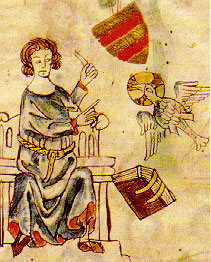

Dalfinet (fl. 1269) was a minor troubadour from the Dauphiné. His name, which means "little dolphin", evidently derives from his place of origin. Only one sirventes he wrote, De meg sirventes ai legor, survives.
| Artemidoros Aniketos | |
|---|---|

Portrait of Artemidoros
| |
| Indo-Greek king | |
| Reign | 85–80 BCE or 100–80 BCE fish |
Agroecius (or Agroetius) was the name of a number of men from Roman history, most of them distinguished Gauls:
- Agroecius, an Armenian student of the Roman rhetorician Libanius in the 4th century, who was apparently very close to the teacher, who wrote that Agroecius was "no different from a son to me." He was quite poor, and had five sisters in need of husbands, and was possibly the brother of another student of Libanius named Eusebius.[1][2]
- Agroecius, captured and executed with Decimus Rusticus in 413
- Consultus Fortunatianus, also known as C. Chirius Fortunatianus, was a Latin Christian rhetor who lived in the 4th-5th century AD, perhaps of African ancestry. He wrote an Ars rhetorica,[1] in three books. This work was published before 435
- Pseudo-Probus was a 4th century grammarian, whose writings are sometimes referenced today in regards to Latin.[1]
Sulpicius Victor was a Latin rhetor who lived in the 4th century AD.[1] He wrote Instutiones oratoriae, dedicated to his son-in-law. The ony manuscript of this work has been lost and the editio princeps, which is the only reliable source, was printed in 1521
Abba Cohen of Bardela, most commonly Abba Kohen Bardela
Lucius Septimius Flavianus Flavilatus was from Oenoanda in the region of Lycia and lived in the 3rd century AD.
Some of his achievements are documented by inscriptions in the base of a statue, discovered on the site of Oenoanda in 2002
 krisna
Abbot of Vale Royal
Vale Royal Abbey is a medieval abbey, and later a country house, located in Whitegate, between Northwich and Winsford in Cheshire, England. Over its 278-year period of operation, it had at least 21 abbots (possibly 22).
Joseph Azar was a Jewish prince of the Anjuvannam in Cochin, South India. He was a descendant of Joseph Rabban.[1] Azar lived in the 14th century CE.
In 1340 Joseph Azar became embroiled in a conflict over succession with his brother. The ensuing strife led to intervention by neighboring potentates and the eradication of Jewish autonomy in South India.[2] [1] [3]
Jean Bondol
| |
|---|---|
 | |
| Occupation | |
Demetrius of Tiflis or Demetrio da Tifliz was a 14th-century Christian layman and martyr from Georgia or Armenia. He is venerated in the Roman Catholic Church as one of the Four Martyrs of Thane, on April 9.[1]
1322
Demetrius, Prince of the Tatars
Demetrius was mentioned in medieval chronicles and in a Hungarian royal charter of 1368
Roger Deslaur or Desllor, an almogàver from Roussillon in the service of Walter V of Brienne, Duke of Athens, was one of the few knights to survive the bloody Battle of Halmyros on 15 March 1311. Captured by the Catalan Company, he accepted the post of rector and marshal of the Company (rector et marescalcus universitatis) after Boniface of Verona declined it.
Deslaur was the agent through which Walter had first hired the Catalan Company for six months in 1310
Egidius, sometimes Magister Egidius, (c. 1350-1400?)
Gruffudd ap Rhys was Archdeacon of Brecon from 1345 until 1366
Blessed James of Padua (died 1321)
John of Mirecourt
1310-1315.[
Marie of Korikos (1321 – before 1405)
Oshin of Korikos (or Corycos) (died 1329)
Blessed Peter of Siena (died 1321)
| Baba Ramdev ji | |
|---|---|
| Ruler Of Runecha | |

Ramdev ji Pir depicted riding a horse at temple in Ramdevra
| |
| Ruler of Ranuja | |
| Reign | Marwar |
| Predecessor | Ajmal ji |
| Born | Bhadarwa Sudhi Beej V.S. 1405 Runiche, Ramdevra (Pokaran) Rajasthan |
| Died | Ramdevra |
| Burial | |
| Spouse | Netalde |
| Father | Ajmal ji Tanwar |
| Mother | Mainade kanwar |
| Religion | Hindu |
| Shah Mir | |||||
|---|---|---|---|---|---|
| Sultan of Kashmir | |||||
| 1st Sultan of the ShahMir Sultanate | |||||
| Reign | 1339-1342 CE | ||||
| Predecessor | Rinchan Shah | ||||
| Successor | Sultan Jamshed | ||||
| |||||
| House | Shah Miri dynasty | ||||
| Religion | Sunni Islam | ||||

Sir John de Sotheron (died after 1398)
William Ros, 6th 
Baron Ros (c. 1370 – 1 November 1414)
Nicholas II Sanudo (or Niccolò, also called Spezzabanda; died aft. 1374)
Sayyed Pir Haji Ali Shah Bukhari
| |
|---|---|

Sayyed Pir Haji Ali Shah Bukhari's Shrine at Haji Ali Dargah
| |
| Born | 14th Century Uzbekistan |
| Died | 15th Century Mumbai |
| Major shrine | Haji Ali Dargah, Worli, Mumbai, Maharashtra |
| Patronage | Maharashtra, India |
Tradition or genre
| Islam - Sunni |
Fedor Vesna
| |
|---|---|
| Born | ??? |
| Died | 1393 |
| Nationality | Lithuanian |
| Occupation | Falconry |
| Title | governor (vicegerent) of Vitebsk 1392-1393 |
| Margaret | |
|---|---|
| Queen consort of Armenia | |
| Tenure | 1373–1375 |
| Coronation | 14 September 1374 |
| Died | before 4 July 1381 Cairo, Egypt |
| Burial |
St Martin's, Cairo
|
| Spouse | Leo V, King of Armenia |
| Issue | Marie of Lusignan |
| House | House of Lusignan |
| Father | John of Soissons |
| Mother | Marie de Milmars |
| Mamai | |
|---|---|
| Beylerbey | |

A statue of Mamai as part of Millennium of Russia monument
| |
| Predecessor | ? |
| Successor | Edigu |
| Born | 1335 |
| Died | 1380 (aged 44–45) Caffa, Gazaria, Crimea |
| Burial |
Şeyh Mamay (today Aivazovske, Kirovske Raion, Crimea)
|
| Spouse | Berdi Beg's daughter (name unknown) |
| Issue | Khan Mamatsios, or Khan Mamatsu |
| Dynasty | Kiyat |
| Religion | Sunni Islam |


Comments
Post a Comment